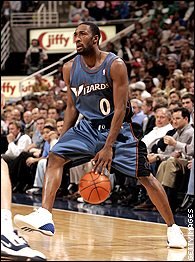
It seems wierd to say this, but let me be the first to do it.
Darius Songaila's injury and the effect it has had on the Wizards bench is the primary reason why the Wizards are 4-9.
Okay, maybe Songaila himself isn't the only culprit. Gilbert Arenas has been hot and cold all year. Antawn Jamison's shot has deserted him. The two have been inconsistent all year, and the overall defensive effort still needs some work.
Still, the injury to Songaila, while not playing a major role on its own, has exposed the Wizards absolute lack of a bench.
It is my firm belief that this problem has caused all the other problems and needs to be fixed.

Commenter
Mel Turpin had this to say.
One of the biggest problems with this team is a total lack of any fire power off the bench. Good teams in the NBA get thirty or forty points per game from their bench. The Wizards are lucky to get ten points.
I'd agree with the sentiment of the statement, but I'd slightly amend the meat of it. A bench doesn't necessarily need to provide scoring, and between Antonio Daniels and Jarvis Hayes, they usually get 10 points most games. What is necessary from a bench is a spark; a player who can play 20-25 minutes and potentially provide the necessary offense, defense, rebounding, or playmaking necessary to win a game. In lieu of one player, many teams like Dallas and San Antonio rely on a lot of bench guys to be successful.
Either way,
you have to have one or the other to be a successful team. San Antonio makes up for the lack of star power with a ton of options, including Brent Barry, Michael Finley, Fabricio Oberto, Francisco Elson, and Beno Udrih. Dallas is very much the same way, but they also have a potential impact player in Jerry Stackhouse. Phoenix relies on the offensive spark of Leandro Barbosa off the bench to win games for them. The Lakers are at least two deep at every position, and Orlando often gets more production out of bench players like Carlos Arroyo and Keyon Dooling than their starters. Even Utah gets a lot of intangible qualities out of guys like Matt Harpring, Ronnie Brewer, and Paul Millsap, and this change has arguably been one of the catalysts to their sudden improvement. Good teams therefore either need to have one of their best players come off the bench (like Barbosa, Harpring, and Mike Miller on Memphis last year ) or have a multitute of options so that someone invariably emerges every night (the Dallas-San Antonio-LA Lakers strategy).
This is ultimately where the Wizards have failed this year. The offense and defense have struggled, but I think it's all tied back to the bench. Only 7 players on the Wizards have a PER (player efficiency rating) over 10. The Hawks, Nets, Heat, Bobcats, and Sonics are the only teams that have a similar lack of efficiency from their bench.
The Wizards bench can basically be summed up as follows.
- Antonio Daniels: Nice player, a personal favorite, but best suited to being a 7th man. Probably isn't good enough to start on a playoff team. If there were 3 players as good as Daniels on this bench, it would be a solid unit, but there isn't.
- Brendan Haywood: Pretty solid backup center, but way too inconsistent to provide a spark every night.
- Jarvis Hayes: Has been really bad this year, with a PER under 9. He takes too many shots and doesn't make enough of them.
- Michael Ruffin: No offensive ability, pretty poor defensive ability, average rebounder, commits tons of fouls, and the team's +/- with him on the floor stinks.
- Calvin Booth: Michael Ruffin, but with slightly more defensive skills and worse rebounding skills.
- Roger Mason, Donnell Taylor, Andray Blatche: Unproven.
With this cast of characters, the Wizards' bench fulfills neither requirement presented above. There are no consistent impact players on the bench, and there isn't enough depth to ensure that the team will get something out of this unit no matter what. Daniels comes closest to being an impact player, but he doesn't really add a new dimension to the team game like Barbosa, Millsap, Ben Gordon, or Jerry Stackhouse do. Haywood is a decent backup center who would be a real asset if the bench was deeper. Hayes and Ruffin receive too many minutes, and nobody else really plays much.

Coming into the season, this wasn't expected to be a problem. At the end of last year, a lack of a bench really killed the Wizards, and Ernie Grunfeld went seeing a remedy to the problem. Songaila and Stevenson were brought in, and combined with the continued maturation of Blatche and the healthy return of Hayes and Etan Thomas, the Wizards were all set to be two-deep at every position. Songaila in particular was a particularly good pickup; he probably would have averaged a solid 10 points and 7 rebounds a game in this system. He would have been a versatile impact player off the bench for the Wizards all year and would have singlehandily significantly upgraded a sore weakness for the Wizards.
Then, Songaila got hurt and threw everything off. Injuries happen, and I'm not blaming the Wizards season on an unfortunate event. But the Wizards have dealt with this setback horribly thus far this season, as Eddie Jordan's shortening of the rotation have put too much strain on the starters all season, which has caused them to press and be prone to spells of inconsistency.
Entering the season, a great point of comparison for the Wizards in terms of their benches were the Sacramento Kings. The biggest knock on Sacramento entering the season was their lack of depth, made possible by a bench that seemed to only include Kenny Thomas and John Salmons. Any injury to their top seven would have potentially killed them. As John Hollinger
said:
The Kings are so lacking off the bench, with their best reserve a year ago ([Kevin] Martin) now forced to start. The frontcourt has obvious weaknesses, but the backcourt is no picnic either -- just to have a decent seven-man rotation would require either [John] Salmons or [Francisco] Garcia to play much better than a year ago, or [Quincy] Douby to hit the ground running.
So far this season, the Kings have suffered a loss from one of their top 7 (Brad Miller) and survived okay. Instead of shortening his rotation, coach Eric Musselman lengthened it, giving extended looks to youngsters such as Salmons, Garcia, and Ronnie Price and old relics like Corloss Williamson. The end result is that Williamson has experienced a revival and Price has emerged as a solid backup guard, thereby giving Sacramento more sources for the spark they desperately need. What was once a putrid bench is now a solid one now that Miller has returned to the lineup.

For the Wizards to improve and snap out of their slump, they need to develop the same type of bench Sacramento did when they lost Miller. Eddie Jordan needs to play the young guys more so they can gain experience where they can be potential sparks off the bench for the rest of the season. Instead of playing Michael Ruffin 8 minutes, why not play Andray Blatche? The kid is still raw, but the only way he will significantly improve is if he gets more playing time. Instead of playing the Big 3 over 37 minutes a game each, why not cut their time down to the 35 minute range and give the remaining minutes to Roger Mason and Donnell Taylor? Mason impressed Jordan in camp, but he barely even gets a look now. If he's not going to play, I don't see any reason to have him on the team.
Here's the current average minutes breakdown of the team, rounding up the decimals.
Jamison: 39
Arenas: 38
Butler: 37
Stevenson: 27
Daniels: 27
Thomas: 22
Haywood: 18
Hayes: 16
Ruffin: 8
Blatche: 7
Booth: 6
Taylor: 5
Mason: 5
Here's what I would propose until Songaila comes back.
Arenas: 38
Butler: 36
Jamison: 33
Stevenson: 27
Daniels: 25
Thomas: 22
Haywood: 20
Hayes: 12
Blatche: 12
Mason: 10
Booth: 8
Taylor: 7
Ruffin: 5
In each situation, the total minutes are the same, but the three youngsters, along with Haywood and Booth, see a hike in their minutes. To compensate, Jamison sees his MPG drop by 6 and Ruffin and Hayes see much less of the court than before.
More minutes for the youngsters is the key to improving this team. The Big 3 are currently forced to do too much, and when they're having a bad game, the team suffers significantly.
The Wizards need to develop a decent bench, or else their fortunes will continued to be tied to Gilbert Arenas' shooting. The only way to do this is to give Blatche, Mason, and Taylor more playing time in the hope that someone can emerge as a decent threat, a la Ronnie Price. Only then will the Wizards make that jump into the East's upper eschelon.
Labels: Andray Blatche, Antonio Daniels, Bench, Brendan Haywood, Calvin Booth, Darius Songaila, Donnell Taylor, Eddie Jordan, Jarvis Hayes, Michael Ruffin, Roger Mason, Sacramento Kings, Team Analysis